Last month, a graphic designer from Karachi messaged me in panic: "Bhai, I saw an AI generate a complete logo in 10 seconds. What will happen to my job? Should I leave creative work?"
I felt his fear because I've felt it too. Two years ago, I watched an AI write a poem that made my jaw drop. For a moment, I thought: "Is this it? Has the machine beaten us?" But then I read a poem written by a grieving father about his daughter. And I realized something crucial.
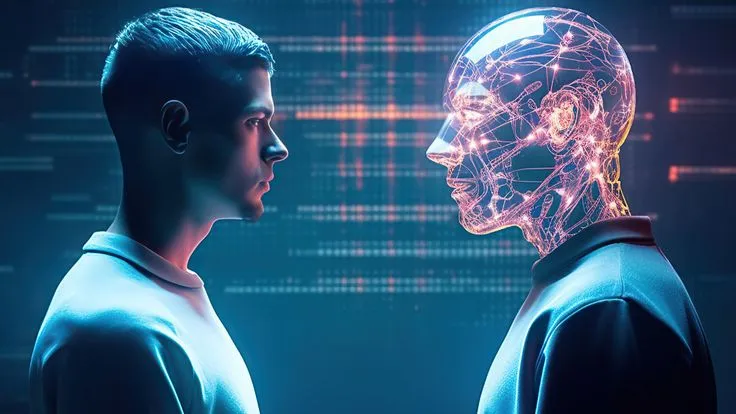
The AI vs human creativity debate isn't just about technology. It's about us. Our fears. Our hopes. Our identity as creators. And as someone who has used both his own imagination AND tools like the EduTech AI assistant, I can tell you: the answer might surprise you.
Let's sit down (virtual chai on me) and explore this deeply. No hype. No doomsday predictions. Just honest, human conversation.
📌 Key Takeaways (Read This First)
- ✅ AI is FAST at generating content — but speed isn't the same as meaning.
- ✅ Can AI replace human creativity? No — because creativity isn't just output; it's lived experience.
- ✅ Humans win at emotional depth, intentional meaning, and authentic vulnerability.
- ✅ The best approach is collaboration: AI handles repetitive tasks, humans focus on soul and strategy.
- ✅ Pakistani creatives who learn AI tools will thrive; those who resist may struggle.
- ✅ Use tools like EduTech AI assistant to brainstorm and speed up workflows — but keep YOUR unique voice.
The Night I Let AI Write My Poem (And What Happened Next)
Let me be vulnerable with you. I'm a writer. Words are my identity. So when ChatGPT first came out, I was terrified. I fed it a prompt: "Write a sad poem about losing a childhood home."
Within seconds, it produced something technically perfect. Rhyme scheme? Check. Metaphors? Check. Emotional language? Yep.
But something felt... hollow. It was like looking at a beautiful wax fruit — all the shape, none of the taste.
Then I wrote my own version. I thought about my grandmother's house in Lahore, the cracked wall where I measured my height every year, the smell of pakoras on rainy evenings. My poem had imperfect rhymes. But my cousin cried reading it.
That's the difference between artificial intelligence and creativity born from a human heart. AI can simulate emotion. It cannot feel it.
Understanding Human Creativity: More Than Just Output
When we talk about human creativity, we're not just talking about making things. We're talking about:
- 💔 Translating heartbreak into a song that heals strangers
- 🎨 Painting memories from a childhood in rural Punjab
- 📝 Writing stories that capture the chaos of Karachi's streets
- 🎭 Creating characters that feel like old friends
Human creativity carries weight. It holds our culture, our pain, our joys, our messy, beautiful contradictions. An AI can write a wedding card. But only a human can write one that makes an aunt cry because it mentions "the way Ammi used to make chai."
How AI "Creates" (The Honest Technical Truth)
Let's demystify AI. Artificial Intelligence doesn't dream. It doesn't get inspired by a sunset or heartbroken by a breakup. Instead, it:
- 📚 Analyzes millions of existing texts, images, or songs
- 🔍 Identifies patterns and probabilities
- ⚙️ Generates new content by predicting what usually comes next
Think of AI as the world's fastest mimic. It has seen EVERYTHING. So it knows what a "sad poem" typically looks like. But it has never actually BEEN sad. That's the gap no algorithm can cross — yet.
Speed and Productivity: Where AI Absolutely Dominates
Okay, let's give credit where it's due. AI is SCARY fast. A Pakistani freelancer using AI tools can:
- Generate 50 social media captions in 2 minutes
- Create 10 logo variations in 30 seconds
- Write a complete blog draft in 60 seconds
- Debug code faster than a junior developer
For businesses and freelancers in Lahore, Karachi, and Islamabad, this efficiency is game-changing. But here's the catch: Quantity without quality is noise. And AI still needs a HUMAN to decide what's good, what's meaningful, and what's trash.
Emotional Intelligence: The Human Superpower AI Can't Steal
Remember that ad for a local brand that went viral last year? The one about a father teaching his daughter to ride a bicycle? It wasn't technically perfect. But millions shared it because it felt REAL.
That's emotional intelligence. That's lived experience. AI can analyze why that ad worked. But it cannot FEEL why it worked.
Human vs AI comparison often misses this point: Humans don't just create content. We create CONNECTION. And connection requires authenticity, which requires life experience.
Originality and Innovation: Who Pushes Boundaries?
Here's an uncomfortable truth: Most human creativity isn't completely original either. We're all influenced by what we've seen, read, and experienced. But humans have something AI doesn't: the ability to REBEL against patterns.
Think about the first person who said "let's put a restaurant on a moving bus" or "let's make a movie where the main character never speaks." Those ideas broke every existing pattern. AI, by its nature, follows patterns. It doesn't rebel. That's why true breakthroughs still come from humans.
Creative Risk-Taking: Why Humans Take Leaps AI Won't
I asked an AI once: "Should I quit my job to become a full-time artist?" It gave me a balanced, safe answer about financial planning and skill development.
A human friend said: "Bhai, if you don't try, you'll regret it forever. Let's figure it out together."
AI optimizes for safety and probability. Humans take risks because of hope, desperation, dreams, and sometimes pure irrational courage. And those risky leaps are where the most beautiful creativity often lives.
Ethical and Philosophical Questions We Can't Ignore
The rise of AI creativity raises uncomfortable questions for all of us:
- 📜 If AI generates a story based on thousands of human-written stories, who owns it?
- 💼 Should a company replace a junior designer with Midjourney?
- 🎨 Is AI-generated art still "art" if no human felt anything making it?
- 🇵🇰 How do we ensure AI doesn't erase Pakistani cultural nuances?
These aren't just technical problems. They're moral ones. And solving them requires human wisdom, not just algorithms.
The Collaboration Model: Your Best Strategy for 2026
After researching this topic for months (and losing sleep over it), I've reached a conclusion: The winners won't be "AI vs humans." The winners will be humans who USE AI wisely.
Think of AI as your super-powered assistant. Here's how I use it daily alongside the EduTech AI tool:
- 🤖 AI handles: First drafts, brainstorming lists, grammar checks, code snippets, research summaries
- 🧠 I handle: Emotional depth, personal stories, cultural context, final judgment, creative direction
This combination produces work that's both efficient AND meaningful. And my clients love it because they get quality work faster.
Real Stories: Pakistani Creatives Using AI (Without Losing Their Soul)
Ayesha, 24, Content Writer from Islamabad: "I use AI to generate headlines and outlines. Then I pour my heart into the actual writing. My productivity tripled, but my voice is still mine."
Bilal, 31, Graphic Designer from Lahore: "AI helps me create 20 rough concepts in minutes. Then I refine the best one with my artistic eye. My clients think I'm a wizard."
Fatima, 19, CS Student from Multan: "I was scared AI would make my coding skills useless. Then I started using it to explain errors and suggest optimizations. Now I learn FASTER."
These aren't people losing to AI. They're people WINNING with AI.
Economic Impact: Will AI Kill Creative Jobs in Pakistan?
Honest answer: Some jobs will change. Low-quality content mills? Yes, AI will replace them. But genuine creative work? The demand is actually growing.
Why? Because as AI generates MORE content, the world becomes noisier. And in a noisy world, AUTHENTIC human voices become MORE valuable, not less.
New jobs are also emerging:
- 🎯 AI Prompt Engineers (people who know how to talk to AI effectively)
- 🔍 Creative AI Supervisors (curating and refining AI output)
- 📚 Ethical AI Consultants (ensuring AI respects culture and rights)
The key is to evolve, not resist.
So, Who Wins the AI vs Human Creativity Debate?
Let me give you my honest, no-BS answer after thousands of hours of thought:
- 🏃♂️ Speed? AI wins, no contest.
- 📈 Scalability? AI wins again.
- 🎨 Pattern recognition? AI is unmatched.
- ❤️ Emotional authenticity? Humans win, every single time.
- 🎯 Intentional meaning? Humans win.
- 🌱 Risk-taking and rebellion? Humans win.
- 🤝 Cultural nuance and lived experience? Humans win.
Final verdict: It's not a fight. It's a partnership. The future belongs to those who combine AI's speed with humanity's soul.
Your Action Plan: How to Thrive as a Creative in the AI Age
- Stop fearing AI — start experimenting with it today. Use the EduTech AI assistant for one task this week.
- Double down on YOUR unique voice — your Pakistani perspective, your family stories, your cultural lens. AI can't replicate that.
- Learn prompt engineering — knowing how to talk to AI is becoming a superpower.
- Focus on emotional intelligence — the human skills (empathy, connection, storytelling) will matter more than ever.
- Build your portfolio of authentic work — show clients why YOU matter, not just your output.
❓ Frequently Asked Questions (FAQ)
1. Can AI replace human creativity completely?
No. AI can simulate creative outputs but cannot replicate genuine human emotion, lived experience, intentional meaning, or cultural authenticity. The AI vs human creativity debate often misses that creativity isn't just output — it's expression of a conscious, feeling being.
2. Will AI take creative jobs in Pakistan?
Some low-skill, repetitive creative jobs may be automated. However, demand for authentic, emotionally intelligent, culturally nuanced creative work is actually increasing. Pakistani creatives who learn to collaborate with AI will have more opportunities, not fewer.
3. How can I use AI as a creative professional without losing my originality?
Use AI for brainstorming, first drafts, research, and repetitive tasks. Then inject YOUR voice, experiences, and emotional depth. Think of AI as a powerful assistant, not a replacement. Tools like the EduTech AI assistant are designed for exactly this collaboration.
4. Is AI-generated content considered original or copyrightable?
This is still legally debated worldwide. Generally, purely AI-generated content (with no human creative input) may not be copyrightable. However, human-AI collaborative works can be protected. Always add significant human creative input to claim ownership.
5. What creative skills will be most valuable in 2026 and beyond?
Emotional intelligence, storytelling, cultural understanding, creative strategy, prompt engineering, and the ability to curate and refine AI output. Technical skills matter, but HUMAN skills (empathy, connection, authenticity) will be your competitive advantage.
🎨 Ready to Collaborate With AI, Not Compete Against It?
Stop worrying about AI replacing you. Start using it to amplify YOUR unique creativity. The EduTech AI Assistant is free, friendly, and designed to help Pakistani creatives work smarter.
🤖 Try EduTech AI Assistant (Free)Join thousands of Pakistani writers, designers, and developers who are thriving with AI.